Ease Back-to-School Anxiety with BrainCore Neurofeedback
Aug 10, 2026
The buses are running again. Homework is back on the kitchen table, practice schedules are taped to the refrigerator, and the whole household is trying to remember how to get out the door on time. The second week of a new schedule is when reality sets in — the nerves that come with a new classroom, the heat of two-a-day practices, the meals eaten standing up, and the aches that show up when everyone's suddenly moving a lot more than they were in July. This week we're focused on helping your family settle in: calming an anxious mind, keeping athletes on the field, easing the tension that builds across the shoulders, supporting digestion when meals get rushed, and taking care of the feet carrying it all.
Office Hours
Mon & Thu: 7:30am–Noon and 1:30–5pm
Tue & Fri: 7:30am–Noon
Wed: 8:30am–Noon and 2–6pm
Phone: 423.542.3337 | Text: 423.380.0877

Ease Back-to-School Anxiety with BrainCore Neurofeedback
Some kids come home from the first week of school lit up. Others come home quiet, with a stomachache that the doctor can't find a cause for, and a growing list of reasons they'd rather not go back tomorrow. Anxiety in children and teens rarely announces itself as "anxiety" — it shows up as stomachaches, headaches, trouble falling asleep, irritability, clinginess, perfectionism, or a flat refusal to talk about it. And it isn't only the students. Parents carry the new schedule too, lying awake running through logistics at midnight. Anxiety is not a character flaw or a discipline problem. Very often it's a brain stuck in a state of high alert, unable to downshift — and that is something a brain can be trained out of.
What Is BrainCore Neurofeedback?
BrainCore Neurofeedback is a drug-free, non-invasive brainwave training program. It starts with a qualitative EEG brain map, which measures brainwave activity across the scalp and shows precisely where patterns are out of balance. In anxious brains, we frequently see excess high-frequency "beta" activity — the electrical signature of a mind that's revving even when nothing is happening — along with too little of the slower, calming activity that lets a person settle. From that map we build a training protocol specific to your brain. During sessions, sensors read your brainwave activity while a video or audio feedback loop rewards the brain each time it produces a healthier pattern. There are no medications, no needles, and nothing painful about it. The brain simply learns, the way it learns anything else — through repetition and feedback.
How BrainCore Neurofeedback Helps With Anxiety and Stress
- It Measures Before It Trains. The brain map shows the actual pattern driving the anxiety instead of guessing at it, so training targets what's really happening rather than a general description of symptoms.
- It Quiets an Over-Aroused Brain. Training helps reduce the excess fast-wave activity associated with racing thoughts, worry loops, and the feeling of never being able to relax.
- It Builds the Brain's Calming Capacity. Just as important as turning down the alarm is strengthening the patterns that allow a brain to rest. Training works on both sides.
- It Improves Emotional Regulation. A better-regulated brain recovers faster from upset. Meltdowns get shorter, the fuse gets longer, and the return to baseline happens sooner.
- It Helps With the Physical Symptoms. Stomachaches, headaches, muscle tension, and a racing heart are the body's response to a nervous system stuck in overdrive. As regulation improves, many of those complaints ease along with it.
- It Helps Sleep, and Sleep Helps Anxiety. Anxious brains struggle to fall asleep, and poor sleep makes the next day's anxiety worse. Neurofeedback often helps break that cycle at both ends.
- It Requires Nothing From an Anxious Child. There's no talking, no homework, and no performance required. The child watches a screen while the brain does the work — which matters enormously for kids who shut down when asked to discuss feelings.
- The Changes Tend to Hold. Because the brain is genuinely learning new patterns rather than having them chemically imposed, gains typically persist after a course of training is complete.
A Word About Working With Your Physician
Anxiety deserves real medical attention, and neurofeedback works best as part of a complete picture of care — not as a replacement for it. Please have your child evaluated by their pediatrician or family physician, particularly if physical symptoms like stomachaches, headaches, or chest tightness are prominent, since those warrant ruling out other causes. If there has been a significant change in eating, sleeping, or weight, a withdrawal from friends and activities that used to matter, or any mention at all of self-harm or not wanting to be here, treat that as urgent: contact your physician or a mental health professional right away, or call or text 988 to reach the Suicide & Crisis Lifeline. We're glad to work alongside your physician, counselor, or therapist, and we'll say so plainly when something is outside what neurofeedback should be handling.
Benefits at a Glance
- Drug-Free: No medication and no side effects to manage.
- Non-Invasive: Comfortable, quiet sessions with nothing painful involved.
- Individualized: Every protocol is built from your own brain map.
- All Ages: Helpful for children, teens, and adults alike.
- Lasting Results: The brain retains the patterns it learns.
If the new school year has brought worry into your house — for your student or for you — you don't have to wait and hope it settles on its own. Contact our office to schedule a BrainCore brain map and find out exactly what's happening beneath the surface.

Keep Your Athlete on the Field with Pulse PEMF
Fall sports don't ease into it. One week your athlete is sleeping until ten, and the next they're running two practices a day in August heat with a game on Friday. Rolled ankles, tight hamstrings, shin splints, sore shoulders, and the deep full-body ache of a body that isn't conditioned yet — it all arrives at once. The problem isn't just the injury; it's the turnaround. There are only so many hours between Thursday's practice and Friday's game, and recovery has to happen inside that window. Pulse PEMF helps the body do exactly that work faster and more completely.
What Is Pulse PEMF?
Pulse PEMF stands for Pulsed Electromagnetic Field therapy. It uses gentle electromagnetic pulses to stimulate and "exercise" your cells, causing them to expand and contract in a way that improves their ability to pull in oxygen and nutrients and flush out waste. Your body is electromagnetic by design — every nerve signal, every muscle contraction, and every heartbeat runs on electrical activity. PEMF supports a process the body is already built around. Sessions are comfortable, drug-free, and require no downtime, which means an athlete can train the same day.
How Pulse PEMF Supports Athletes and Recovery
- Shortens the Turnaround Between Sessions. Enhanced cellular exchange helps the body complete its repair work faster, which matters when the next practice is tomorrow morning.
- Supports a Healthy Inflammatory Response. Swelling after a rolled ankle or a hard collision is normal — but a prolonged inflammatory response is what turns a two-day problem into a two-week one.
- Speeds Soft-Tissue Repair. Strained muscles, tweaked hamstrings, and irritated tendons all depend on cellular function to rebuild. PEMF supports that process directly.
- Boosts Cellular Energy. Supporting ATP production gives working muscle more fuel for both performance and recovery.
- Improves Circulation to Working Tissue. Better blood flow means more oxygen and nutrients reaching the muscles that just got worked hard.
- Releases Muscle Guarding. After an injury, surrounding muscles tighten protectively and stay that way. The pulsing action helps them let go so movement patterns return to normal.
- Helps Prevent the Compensation Injury. Athletes who favor a sore ankle end up with a hip or knee problem two weeks later. Getting the original issue resolved quickly heads that off.
- Fits Between Practices. Sessions are short and require no recovery time, so they work around a real practice and game schedule.
Benefits at a Glance
- Drug-Free: No pills, no side effects, nothing to clear with a coach or trainer.
- Non-Invasive: Nothing more than lying comfortably on the Pulse mat.
- Fast Sessions: Built to fit a packed fall calendar.
- Whole-Body Support: Works at the cellular level everywhere at once.
- All Levels: Helpful for middle school players through adult recreational athletes.
Don't let a nagging injury cost your athlete half a season. Contact our office to schedule a Pulse PEMF session and give the body the recovery support it's asking for.

Ease Shoulder Pain and Upper Back Tension with the Gonstead Method
There's a specific kind of ache that lives between the shoulder blades and across the tops of the shoulders. It builds through the day, gets worse the longer you sit, and by evening it feels like someone has been standing behind you squeezing. You roll your shoulders, you stretch, you dig a thumb into the spot — and it comes right back. Sometimes it travels into the shoulder itself, making it uncomfortable to reach overhead, sleep on that side, or lift anything above chest height. That pattern almost always has a mechanical source in the mid-back and rib joints, and mechanical problems respond to mechanical solutions.
What Is the Gonstead Method?
The Gonstead Method is a specialized chiropractic technique developed by Dr. Clarence Gonstead. Rather than adjusting broadly and hoping the right segment gets caught, it uses a thorough five-factor analysis — patient history, visual inspection, static and motion palpation, instrumentation, and X-ray — to identify exactly which vertebrae or rib articulations are misaligned and creating nerve interference. In the thoracic spine, where twelve pairs of ribs attach to twelve vertebrae, that precision matters a great deal. Every adjustment is specific to your spine and your problem.
How Gonstead Chiropractic Helps Shoulder and Upper Back Pain
- Finds the Segment Actually Involved. The five-factor analysis pinpoints the specific thoracic vertebra or rib joint driving the pain rather than treating the whole region generically.
- Addresses Rib Restrictions. A restricted rib head produces a sharp, stubborn pain between the shoulder blades that no amount of stretching resolves — because the joint itself isn't moving.
- Relieves Nerve Interference. The nerves supplying the shoulder, arm, and upper back exit the cervical and thoracic spine. Restoring alignment takes pressure off those pathways.
- Breaks the Guarding Cycle. Muscles tighten around a joint that isn't moving properly and stay tight. When the joint is restored, the muscles can finally release.
- Improves Shoulder Mechanics. The shoulder blade has to glide across a properly positioned rib cage. When the mid-back is stuck, the shoulder joint takes up the slack and gets irritated.
- Corrects Rounded, Forward Posture. Hours at a desk, a steering wheel, or a phone pull the shoulders forward and lock the mid-back into a flexed position. Adjustment plus posture guidance helps reverse it.
- Restores Rotation and Reach. Freeing restricted thoracic segments makes it easier to twist, reach behind you, and lift overhead without a catch.
- Goes After the Cause. Rather than chasing the knot with another massage or another pain reliever, the goal is to remove what keeps re-creating it.
Benefits at a Glance
- Precise: Specific adjustments to specific segments and rib joints.
- Drug-Free: Relief without another bottle in the medicine cabinet.
- Targets the Mid-Back Directly: Where most shoulder-blade pain actually originates.
- Supports Better Posture: Helpful for desk workers, drivers, and students.
- All Ages: Appropriate care for kids, teens, and adults.
If you've been living with a knot between your shoulder blades that never quite goes away, there's a reason it keeps coming back. Contact our office to schedule a Gonstead evaluation of your mid-back and shoulders.
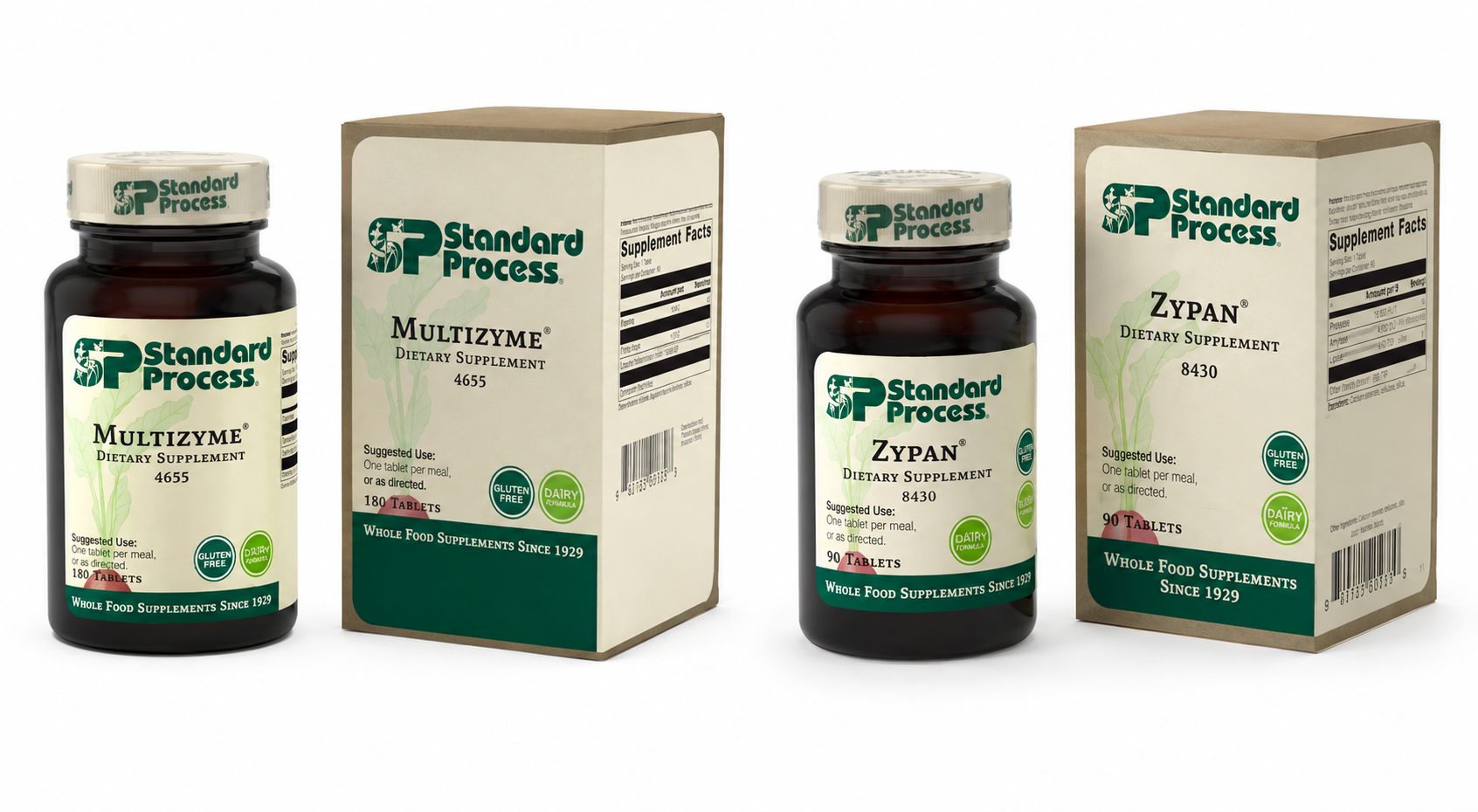
Support Digestion Through a Rushed Schedule with Zypan® and Multizyme®
Look at what happens to eating when school starts. Breakfast becomes something grabbed on the way to the car. Lunch is whatever the cafeteria is serving, eaten in twenty minutes. Dinner is between practice and homework, or in the car on the way to a game. Meals get faster, less chewed, and more processed — and the bloating, heaviness, gas, and reflux that follow are the predictable result. Digestion is not automatic; it's a chemical process that takes the right acid, the right enzymes, and enough time. Two Standard Process products address different stages of that process, which is exactly why we like them together: Zypan® and Multizyme®.
What Are Zypan® and Multizyme®?
Zypan® works on the stomach phase of digestion. It combines betaine hydrochloride, pepsin, and pancreatin to support the acidic environment the stomach needs to begin breaking down protein properly.* When that first stage falls short, everything downstream has to work harder — which is often why meals sit heavy and uncomfortable.* Multizyme® picks up further along, supplying a broad blend of digestive enzymes including pancreatin, papain, amylase, lipase, and cellulase to support the breakdown of proteins, fats, carbohydrates, and fiber.* Zypan® supports the beginning of the process and Multizyme® supports what comes after, so together they cover the sequence rather than a single point in it.*
How Zypan® and Multizyme® Work Together
- They Address Two Different Stages. Zypan® supports stomach-phase digestion; Multizyme® supports enzymatic breakdown further along. Neither one covers the whole sequence alone.*
- They Support Healthy Protein Digestion. Betaine hydrochloride and pepsin support the acidic conditions protein breakdown depends on.*
- They Support Fat and Carbohydrate Breakdown. Lipase and amylase in Multizyme® support the digestion of the fats and starches that dominate a rushed schedule.*
- They Help With Fiber. Cellulase supports the breakdown of plant fiber, which many enzyme formulas leave out entirely.*
- They Support Nutrient Absorption. Food you can't break down properly is food whose nutrients you don't fully receive. Supporting digestion supports what you actually get from a meal.*
- They Support Post-Meal Comfort. Better breakdown means less of the heaviness, bloating, and fullness that follow a meal eaten too fast.*
- They're Whole Food Based. Standard Process grows ingredients on their own certified organic farm and delivers nutrients in the complex form nature intended.*
- They Fit a Real Schedule. Taken with meals, they require no meal planning overhaul to be useful during the busiest stretch of the year.*
Benefits at a Glance
- Sequential Support: Two stages of digestion, not just one.*
- Broad Enzyme Coverage: Protein, fat, carbohydrate, and fiber.*
- Whole Food Sourced: Nutrients from real food, not synthetic isolates.*
- Trusted Quality: Standard Process has served practitioners for over 90 years.
- Simple to Use: Taken with meals, no routine overhaul required.*
If meals have been sitting heavy since the schedule picked up, there's a reason. Contact our office to talk through whether the Zypan® and Multizyme® pairing is right for you. You can pick them up at the office or order online and have them shipped directly to your door.
*These statements have not been evaluated by the Food and Drug Administration. These products are not intended to diagnose, treat, cure, or prevent any disease.

That First Step Out of Bed: Relieving Heel Pain with Foot Levelers
You know the feeling if you've had it. That first step out of bed in the morning sends a sharp, stabbing pain through the bottom of the heel, and you hobble to the bathroom on the outside of your foot until it loosens up. It eases after a few minutes of walking, so you tell yourself it's fine — and then it comes right back after you sit through a meeting, or a drive, or the second half of a ball game. Plantar fasciitis is one of the most common foot complaints we see, and it is remarkably stubborn when the underlying mechanics never get addressed.
What Are Foot Levelers Orthotics?
Foot Levelers orthotics are custom-made Stabilizing Orthotics built from a 3D scan of your individual feet. The critical difference from a generic insole is arch support: most off-the-shelf inserts address the inner arch only, if any. Your foot actually has three arches working together, and it's that three-arch structure that controls how the foot loads and unloads with every step. When the arch structure collapses, the plantar fascia — the thick band of tissue running from the heel to the ball of the foot — gets stretched and strained thousands of times a day. Foot Levelers are available in styles built for work boots, athletic shoes, dress shoes, casual wear, sandals, and flip-flops. We offer a free foot scan right here in the office.
How Foot Levelers Help Heel Pain and Plantar Fasciitis
- Reduces Strain on the Plantar Fascia. Supporting the arch structure means the fascia isn't being pulled to its limit with every step you take.
- Supports All Three Arches. Full arch support is what actually controls foot mechanics; cushioning one spot only masks the symptom.
- Addresses the Repetitive Load. Heel pain is rarely one injury — it's the same small strain repeated thousands of times daily. Changing the mechanics changes the math.
- Absorbs Shock at Heel Strike. Tile, concrete, gym floors, and pavement give back every bit of force you put into them. Proper support takes that impact instead of your heel.
- Helps the Morning Pain Specifically. That first-step pain comes from tissue that tightened overnight being loaded abruptly. Reducing the daily strain gives it a chance to actually heal.
- Levels the Whole Foundation. When the feet are balanced, the knees, hips, and spine sit level too, which reduces the compensations that show up when you limp.
- Supports Both Foot Types. Flat feet and high arches both strain the fascia, for different reasons. A custom orthotic is built for the foot you actually have.
- Complements Chiropractic Care. Adjustments hold better when the foundation beneath the spine isn't pulling things back out of alignment.
Benefits at a Glance
- Custom Made: Built from a scan of your own feet, not a generic mold.
- Targets the Cause: Addresses the mechanics driving the strain.
- Free Scan: No cost to find out what your feet actually need.
- Multiple Styles: Work, athletic, dress, casual, and sandal options.
- Durable: Built to hold up through long days and long seasons.
You shouldn't have to dread the first step of your morning. Contact our office to schedule your free Foot Levelers scan and find out what's driving that heel pain.
Settling Into the Season
The second week of a new schedule is when everyone finds out what's actually going to work and what isn't. If the answer this year includes an anxious student, a sore athlete, a knot between your shoulder blades, meals that aren't sitting right, or a heel that hurts every morning, none of that has to be something you simply push through until Christmas break. Whether it's calming an over-revved brain with BrainCore, getting an athlete recovered with Pulse PEMF, freeing up the mid-back with a Gonstead adjustment, supporting digestion with Zypan® and Multizyme®, or getting your feet properly supported with Foot Levelers, we're here to help your whole family settle into this season feeling their best.
Give us a call at 423.542.3337 or text us at 423.380.0877 to get scheduled. We'd love to see you.
Yours In Health, Dr. Dennis & Your EC Team (Larry & Zak)!